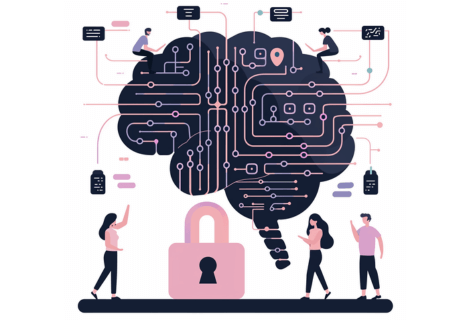
In today’s technology world, the term “machine learning” is becoming increasingly popular. Its discussed in the media, in business, and even among ordinary users. But what does machine learning mean, and how does it work? Let’s look at this together.

Let’s start with what machine learning is.
Machine learning (ML) is a branch of artificial intelligence that studies the development of algorithms and models that learn to make predictions and make decisions based on input data. It allows computers to “learn” without explicit programming, recognizing patterns in data and using them to make decisions. Machine learning is being applied in various fields, including medicine, finance, marketing, manufacturing automation, and many others, and it is changing how we work and live.
What are the types of machine learning?
There are several machine learning types, including supervised, unsupervised, and reinforced learning.
- In supervised learning, the model receives input data and its associated output labels, which helps it learn the relationships between input and output data.
- In unsupervised learning, the model learns the structure of the input data without labels, allowing it to identify hidden patterns or groups in the data set.
- In reinforcement learning, the model learns based on interaction with the environment and the results of this interaction.
Examples of application of machine learning.
The applications of machine learning are very diverse. Here are some examples:
- Recommender systems.
Platforms like Netflix or Spotify use machine learning to analyze user preferences and recommend content. - Medical diagnostics.
Machine learning analyses images, diagnoses diseases, and predicts population trends in medicine. - Forecasts.
Machine learning algorithms are used to analyze financial data, predict prices, and detect fraud in the financial sector. - Autonomous vehicles.
Companies like Tesla and Waymo are using machine learning to develop self-driving systems and intelligent vehicles. - Natural language processing.
Platforms such as Google Translate or Siri use machine learning to translate texts and recognize language automatically.
These are just a few examples of how machine learning changes our lives and influences different areas of our existence.
The main challenges that may be encountered in machine learning research and application are:
- Poor quality data.
Data quality is critical to successful model training. Incorrect, incomplete, or skewed data can lead to inaccurate results or even cause the model to fail. - Underestimation of results.
Sometimes, model results can be misinterpreted or underestimated due to the complexity of their structure or lack of understanding of the correlations between the data. - Limitation of computing resources.
Some complex machine learning algorithms require significant computational resources, such as large-scale computing networks or deep learning, which can be a limiting factor for some researchers or companies. - Ethical issues.
The use of machine learning may raise ethical questions, particularly regarding algorithm transparency, data privacy, and the potential social consequences of process automation.
The future of machine learning.
With advances in data technology and computing power, machine learning is becoming an increasingly powerful and widespread tool for solving complex problems across industries. So, what is the future of machine learning?
- Increased automation.
Machine learning will continue to improve automation processes across industries, from manufacturing to business, helping to streamline workflows and reduce costs. - Improved medical diagnostics.
With the development of machine learning technologies, the possibilities of accurate medical diagnostics will increase. This will help detect diseases in a timely manner and increase the effectiveness of treatment. - Creation of intelligent assistants.
In the future, we expect the development of intelligent assistants that can interact more effectively with people by understanding their needs and intentions. - Expanding areas of application.
Machine learning will continue to find new applications, including autonomous vehicles, environmental modelling and space exploration. - Improving your personal life.
Thanks to machine learning, we can expect better tools for managing personal finances, health, and education, which will help us achieve greater levels of comfort and satisfaction in life.
Overall, machine learning is an exciting field of research and development, with many opportunities for innovation and automation. Due to its various uses, it is becoming an essential part of modern technology.